
What the Rest of the World Knows About Living Together
Lessons from other aging societies—and what America is missing.
The American single-family home promised independence and self-reliance. But that promise was always a fiction. It worked only because someone (almost always a woman) performed full-time, unpaid labor: cooking, cleaning, childcare, elder care. And it worked only because that household was embedded in a thick web of neighbors who knew each other, religious and social organizations, and civic institutions that caught people when they fell.
The unpaid labor hasn't disappeared; it's just been squeezed into evenings and weekends, or outsourced to a patchwork of paid care that most families can't afford. The community infrastructure has eroded almost entirely. What's left is the house itself: isolated, expensive, and designed for a support system that no longer exists.
Meanwhile, demographics have shifted underneath us. 28% of American households are now people living alone—many of them older adults in homes built for families they no longer have. Loneliness has become a public health crisis serious enough for the Surgeon General to issue an advisory.
These aren't separate problems. The daughter driving across town to check on her father and the widower eating dinner alone are living out two sides of the same failure. We built housing that assumes families are nuclear, self-sufficient, and rooted in one place—then watched as families shrank, women entered the workforce, and children moved away
Other countries are further along in this demographic transition, and they've been experimenting. Their experiments reveal what actually makes multigenerational living work—and what America is missing.
Germany: A government spark, a supportive ecosystem
Germany is one of the oldest societies in Europe; 22% of its population is over 65. It also has a longer history with intentional multigenerational housing than almost anywhere; Berlin alone has over 400 such projects. But in 2009, the federal government decided to see what would happen if it actively encouraged more.
The resulting program, Wohnen für (Mehr)Generationen (Housing for Multiple Generations), funded 30 pilot communities across the country. The approach was notably light-touch: grants of around €100,000 per project to support design and development, not construction. Projects were selected through a national competition, judged on how well they supported residents' independence and self-determination, fostered mutual support across generations, and contributed to neighborhood life.
Research on German multigenerational housing—including communities funded by programs like Wohnen für (Mehr)Generationen—suggests the model works. A study comparing residents of multigenerational communities to those in conventional housing found the community residents reported better health, and the gap widened over time. They also reported stronger support networks and greater civic participation. When researchers asked older residents about their plans, almost none intended to leave.
But the challenges are just as instructive. Wohnen für (Mehr)Generationen projects took five to seven years from conception to move-in. Assembling financing was the primary bottleneck, and families with young children often couldn’t wait and dropped out, leaving projects that skewed older than their founders had envisioned. The communities that succeeded required extraordinary organizing capacity from residents, plus outside advisors to navigate zoning, financing, and construction.
The federal grants certainly helped, funding shared spaces and providing early momentum. But the real infrastructure came from wider society: decades of cooperative housing culture, nonprofit organizations like Stiftung trias (Trias Foundation) that could advise on financing and legal structure, and networks of existing communities that mentored new ones.
Germany's lesson: community-led multigenerational housing can work, but it asks future residents to do the work of developers—for five to seven years, without pay, before they can move in. The question is whether that's the only way.
Japan: Designing for ikigai
In Japan, nearly 30% of the population is over 65, and one in five elderly Japanese lives alone. The traditional family caregiving structure has collapsed—there simply aren't enough working-age children to care for aging parents, even if they wanted to.
The response has been a wave of experimentation, much of it organized around the concept of ikigai, which roughly translates to "a reason for being." The research on ikigai is striking. A seven-year study of over 43,000 Japanese adults found that those lacking a sense of ikigai had 50% higher mortality rates—driven largely by cardiovascular disease. More recent research links ikigai to a 31% lower risk of functional disability and 36% lower risk of dementia. Sensibly, Japan's government has made cultivating ikigai a formal policy priority. No surprise then that Japan’s housing experiments don't just accommodate older people, they design for purpose.
Share Kanazawa, in a midsize city on the Sea of Japan coast, is a village where about 40 older adults live alongside 32 young people with disabilities and 8 university students. The government provides the land and funding, and BUSSI-EN, a nonprofit, runs it. BUSSI-EN started decades ago with group homes for children with special needs, then expanded to adults, then to seniors—learning along the way that mixing populations created something none could achieve alone. Older residents mentor younger ones; students bring energy and connection to the outside world; and everyone works or volunteers in the village's small businesses. The operating philosophy: everyone receives care, and everyone gives it.
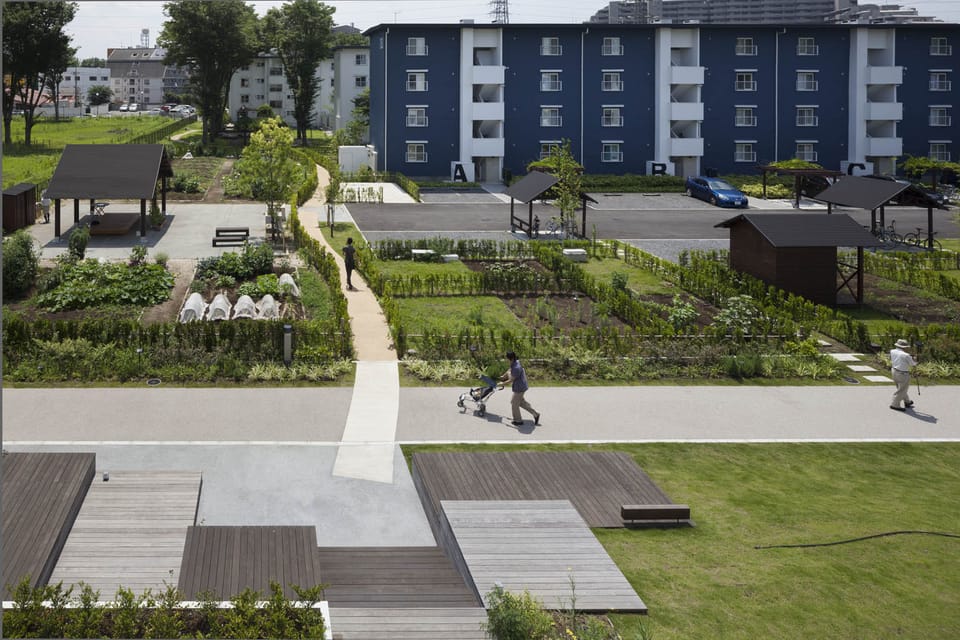
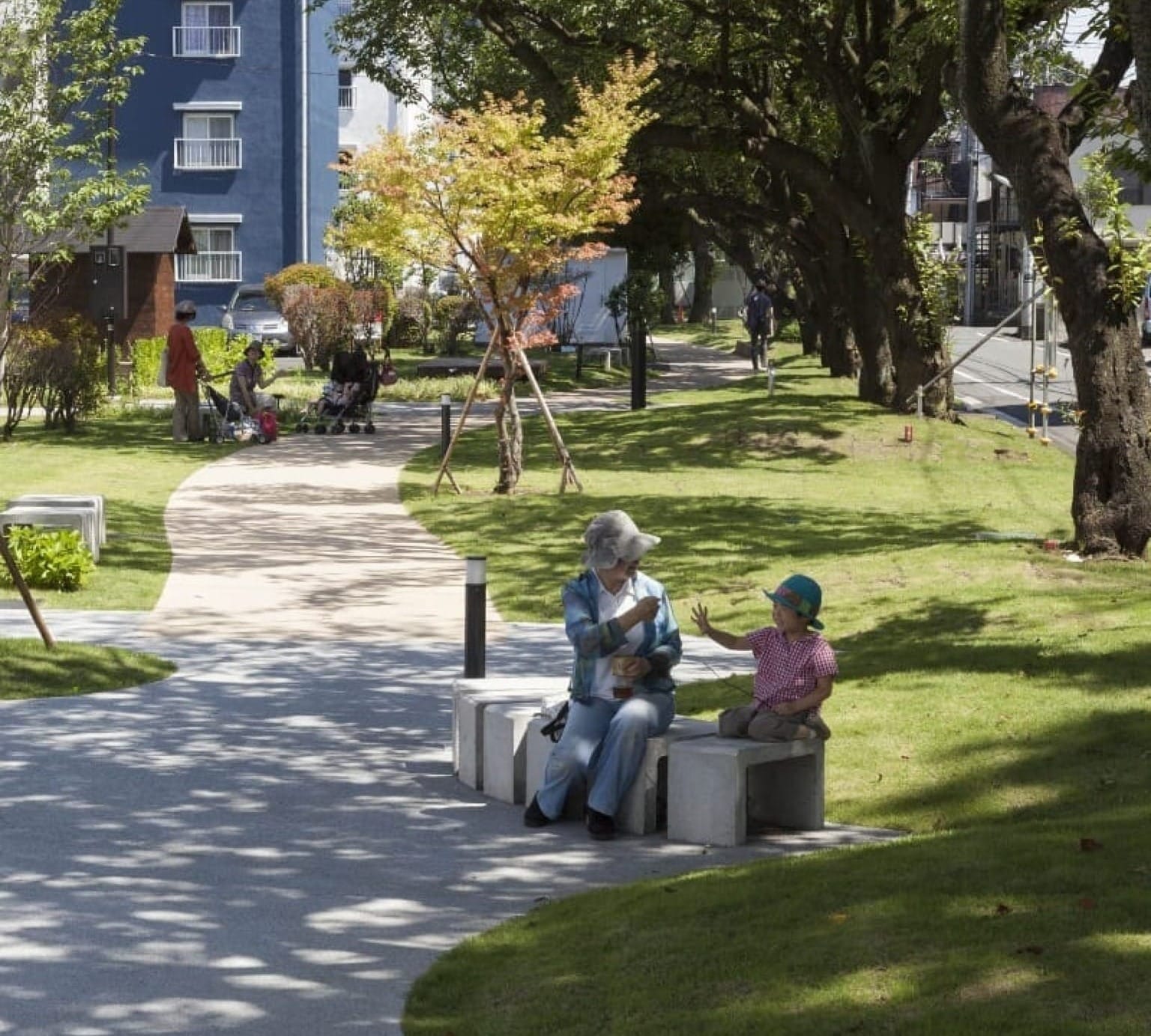
Toyoshikidai, in Kashiwa City outside Tokyo, is a larger scale, 20-year project converting 103 aging apartment buildings into 4,666 multigenerational units. The partnership behind it—the city, the quasi-governmental Urban Renaissance Agency, and the University of Tokyo's Institute of Gerontology—redesigned both the buildings and the social infrastructure around them. A kindergarten is housed inside the senior care facility. Older residents work part-time managing community gardens, staffing childcare, and providing social services—roles that come with a guaranteed minimum wage and flexible hours. Proximity creates the conditions for connection, but intentional structure makes it happen.
Japan's lesson is twofold. First, purpose isn't a nice-to-have; it's a health intervention. Second, mixing residents of varying ages and abilities is only half the purpose equation. The other half is intentional design and consistent, committed partners who will sustain it over decades.
A note on the rest of the world
Outside wealthy, aging societies—in Latin America, Sub-Saharan Africa, South Asia, the Middle East, Southeast Asia—populations are younger, with higher birth rates and larger households. Multigenerational living isn't a design innovation; it's the baseline. Three generations under one roof, or next door, remains common. The "intentional" part is less necessary when the culture never abandoned it. The countries experimenting most aggressively with multigenerational housing are the ones that most aggressively dismantled it: wealthy, aging, nuclear-family societies now trying to rebuild what they lost.
United States: A nation of niche movements
America isn't devoid of multigenerational experiments. There are roughly 300 cohousing communities, many of them intergenerational by intent. There are "grandfamily" programs serving the 2.5 million grandparents raising grandchildren. And there are over 80 university retirement communities (URCs), where retirees live on or near campus and audit classes.
Each has real value. None has cracked the code. Cohousing requires years of resident organizing and typically prices out anyone without savings or flexible work. Grandfamily programs address crisis, not prevention; they support families already stretched thin, rather than building communities that prevent the stretching. And URCs, despite their campus adjacency, are age-segregated by design: seniors in one building, students in another, families nowhere.
What America is missing
The international experiments share a common thread: someone has to do the hard parts. Land, capital, development expertise, long-term management—in Germany and Japan, that burden is shared among residents, government, civil society, and institutional partners. In America, it typically falls on residents alone, which is why multigenerational housing remains rare. But America has assets most other countries don't: a world-renowned university system and a private sector that moves fast. What if they teamed up to fill the gap?
Universities have desirable land in vibrant communities where people actually want to live. They have programming—courses, lectures, arts, sports—that residents would otherwise have to create from scratch. And they are increasingly defining their missions around lifelong learning, multigenerational by design. Pair that with a mission-driven developer who can move faster than resident groups ever could, and you have the combination that's been missing.
That's the bet we're making at Rekindle. We’ll be sharing more about it soon.